 |
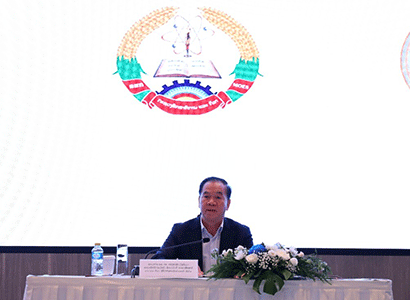
| Assoc. Prof. Dr Thongsalith Mangnomek chairs the National Nutrition Forum and annual meeting of the National Nutrition Committee. |
Laos makes progress on nutrition, sets priorities for 2026
The government has made significant progress in reducing child malnutrition, cutting the number of provinces with severe malnutrition rates exceeding 40 percent from eight in 2017 to four in 2023, according to the Lao Social Indicators Survey III conducted in 2023.
The child malnutrition rate in Xekong province fell from 54 percent to 35 percent, while in Phongsaly province the rate dropped from 56 percent to 43 percent, reflecting steady progress in tackling nutrition challenges.
These achievements were highlighted at the National Nutrition Forum and annual meeting of the National Nutrition Committee 2025, held on July 28.
The meeting was chaired by Deputy Prime Minister, Minister of Education and Sports, and Chairman of the National Nutrition Committee, Assoc. Prof. Dr Thongsalith Mangnomek.
More than 350 representatives from government agencies, development partners, and other organisations attended the forum. Deputy Minister of Health Dr Vannasay Sattakoun outlined nutrition-related activities carried out in 2025 and priorities for 2026.
Participants reviewed progress under the National Nutrition Action Plan, discussed remaining challenges, and identified measures to improve nutrition outcomes across the country.
The forum also reviewed achievements under previous nutrition programmes and considered the National Nutrition Strategy 2026-2035 and the National Nutrition Action Plan 2026-2030 for endorsement.
The meeting supported the establishment of national and local nutrition committees in line with the strategy's multisectoral approach and discussed strengthening coordination between the National Nutrition Committee, food production systems, social protection, and climate coordination platforms.
Progress was also reported in maternal and child nutrition. Many provinces achieved or exceeded the target of having at least 80 percent of newborns breastfed within the first hour after birth. Xiengkhuang and Phongsaly provinces both reached 100 percent.
In terms of water, sanitation and hygiene, all 18 provinces were declared open defecation-free, covering 8,684 villages in 148 districts, while nationwide access to clean water reached 97.78 percent.
Food security also improved. A total of 3.77 million metric tonnes of rice were produced, achieving 96.7 percent of the target figure, while 570 metric tonnes of meat, fish and eggs were produced, and more than 36,000 poor households were assisted in moving out of poverty.
In the education sector, nutrition has been integrated into the curriculum of all schools nationwide, while the school lunch programme has expanded to 3,353 schools, benefiting 244,824 children.
Despite the progress, the government identified three urgent priorities for 2026: resolving shortages of iron and folic acid supplements for women and adolescent girls, increasing full childhood vaccination coverage to at least 50 percent, and improving the quality of data in the District Health Information System 2 to support evidence-based planning and nutrition investments.
Assoc. Prof. Dr Thongsalith Mangnomek called on ministries, organisations, development partners, and the Secretariat of the National Nutrition Committee to strengthen coordination and accelerate the implementation of nutrition programmes.
He stressed the need to align budget allocations with national priorities, ensure effective management of government funding, grants, and international financing, and strengthen monitoring and evaluation through agreed indicators.
Dr Thongsalith also called for regular nutrition surveillance, stronger nutrition research, and greater use of data from the national nutrition database to guide evidence-based policies and improve nutrition outcomes.
By Phetphoxay Sengpaseuth
(Latest Update August 4, 2026)
|

