 |
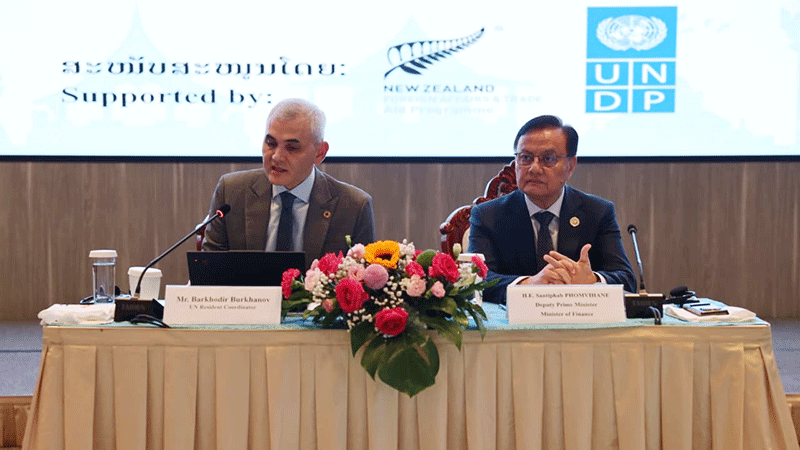
Deputy Prime Minister and Minister of Finance, Mr Santiphab Phomvihane (right), and United Nations Resident Coordinator in Laos, Mr Bakhodir Burkhanov, co-chair the 2026 Round Table Meeting in Vientiane on Thursday.
|
Govt outlines plans to bridge development financing gap following LDC graduation
The government plans to strengthen revenue collection, improve spending efficiency, and attract greater private investment to narrow the development financing gap, with Laos slated to transition out of Least Developed Country (LDC) status on November 24.
An estimated US$17-17.8 billion is needed to finance the 2026-2030 National Socio-Economic Development Plan, but available financing amounts to just US$9.5-9.8 billion, leaving a shortfall of US$7.5-8 billion, according to the Ministry of Finance.
Deputy Prime Minister and Minister of Finance, Mr Santiphab Phomvihane, outlined measures to narrow this gap during talks with development partners at the 2026 Round Table Meeting in Vientiane last week.
Participants discussed funding priorities for 2027 and continued international support during Laos’ transition from Least Developed Country status.
DPM Santiphab said the government plans to address the shortage through public finance reform, increased revenue collection, more efficient spending, public-private partnerships, and new financing mechanisms, including blended finance.
These measures are planned to counteract the projected decline in development assistance.
United Nations Resident Coordinator in Laos, Mr Bakhodir Burkhanov, said Official Development Assistance (ODA) is expected to decline by between 10-15 percent. Laos currently receives an average of US$600 million in ODA annually.
With development partners pledging continued support for Laos during the transition phase, Mr Santiphab reaffirmed the government's commitment to the responsible use of development aid.
“We will manage and use ODA transparently, with the greatest effectiveness and sustainability, so as to bring real happiness and benefit to the multi-ethnic people of Laos,” he told the meeting.
He called on development partners and other relevant sectors to work together to mobilise resources for the five-year development plan, strengthen human resources, stimulate the domestic economy, and gradually reduce dependence on external financing.
Mr Burkhanov highlighted the importance of securing new funding sources given Laos’ imminent transition from LDC status.
“Lao PDR’s development trajectory crucially depends on new sources of development finance, and a shift from funding to financing,” he said.
He stressed the need to increase domestic financing, including funding for essential social services, while maintaining economic stability and debt sustainability.
The meeting also reviewed the government’s economic performance in 2026 and outlined development targets for 2027.
The government estimates economic growth of 5.1 percent in 2026, below the planned 5.5 percent, partly because of widespread flooding this year, an outbreak of African swine fever, and instability in the Middle East.
Despite these challenges, budget revenue is expected to reach 91,813 billion kip, equivalent to 21.7 percent of gross domestic product, exceeding the planned 20 percent.
Inflation has dropped to single digits since May, while currency exchange rates have become more stable.
The government has set an economic growth target of at least 5.8 percent in 2027, with revenue expected to reach 104,475 billion kip and total investment targeted at 111,730 billion kip. Inflation is to be kept at or below 5.7 percent.
With Laos set to rise above LDC status, the government has prepared a Smooth Transition Strategy for the years 2026-2029, supported by 12 policy measures. These include negotiations on preferential trade arrangements with the European Union, preparations for changes affecting the pharmaceutical sector and rules of origin, access to climate finance, and private sector development.
The government called on development partners to maintain preferential arrangements and continue providing financial and technical assistance, as well as support for capacity building, during the transition period.
The meeting also reviewed progress under the 3rd Vientiane Declaration Country Action Plan, which aims to strengthen transparency, accountability, and the effectiveness of development cooperation.
According to the Ministry of Finance, 40 percent of Official Development Assistance funds was disbursed during the first nine months of 2026, with approximately 90 percent expected to be disbursed by year-end.
Participants also discussed ways to accelerate progress towards Laos’ upper-middle-income country status through workforce development, food security, nutrition, innovation, green growth and stronger domestic business competitiveness.
At the close of the meeting, Mr Santiphab outlined four priorities for further action: linking development plans with state budget allocations, mobilising resources through closer sector-level cooperation, preparing for the transition after LDC graduation, and strengthening coordination, monitoring and evaluation.
He stressed that the success of the meeting would depend on turning its recommendations into practical measures that produce tangible results.
The Ministry of Finance will coordinate with the relevant sectors to compile the meeting's outcomes and report them to the government to guide future development planning and budget allocations.
The meeting was supported financially and technically by the Government of New Zealand and the United Nations.
By Times Reporters
(Latest Update November 23, 2026)
|

