 |
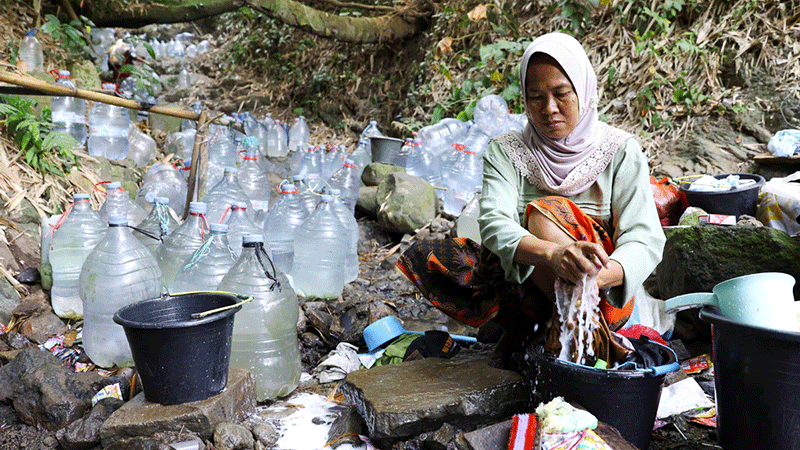
| A villager does laundry in a drought-hit area during the dry season, amid forecasts that El Nino may contribute to drier-than-normal conditions, in Gunung Batur village, Cilegon, Banten province, Indonesia. |
Asian economies face risks to food security
(China Daily/BRNN) -- Asia’s economies are staring down a double shock: a looming super El Nino threatens to deepen food insecurity just as the Middle East crisis drives up energy and fertiliser costs.
Analysts said a prolonged dry spell could slash crop yields and push food prices further out of reach for consumers already squeezed by surging inflation.
“The impact of El Nino is just among the many crises that we are facing at the moment,” said Paul Teng, a visiting senior fellow in the Climate Change in Southeast Asia Programme at the ISEAS-Yusof Ishak Institute in Singapore.
Teng said geopolitical tensions in the Middle East, which have driven global oil prices higher, are rippling through Asia’s transport and farm sectors, fueling inflation across the region. The surge has been compounded by what he called a “fertilizer shock”, as the Middle East is a major exporter of crop nutrients.
He said that rising fertiliser costs are forcing farmers to cut back either on usage or on the land they plant this season. The squeeze on inputs is expected to weigh on harvests in the next crop cycle, adding another layer of pressure to food prices.
“On top of that is El Nino, which is like adding oil to fire,” Teng told China Daily, referring to the periodic weather pattern that is expected to intensify further from this month, heightening the risks of extreme weather.
Oil prices started skyrocketing soon after the United States and Israel began attacking Iran on February 28. The Asian Development Bank, or ADB, said as the crisis in the Middle East evolved, inflation also rose across the developing Asia-Pacific region.
Headline inflation in the region increased from 2.9 percent in January to 4.1 percent in May on the back of higher global energy prices, the ADB said in its latest economic outlook report published in July.
The Manila-based lender said that since March, governments across the region have introduced measures to limit pass-through to consumer prices, including fuel subsidies, tax cuts, price controls, releases from strategic petroleum reserves and energy conservation policies. But inflationary pressures persist, with higher logistics and fertiliser costs spiking food prices.
The ADB sees inflation across the region hitting 4.3 percent by end-2026, up from the 3 percent recorded in 2025.
Japanese investment bank Nomura said in its latest report that El Nino may lead to trade protectionism in the coming months. It noted that in the past, countries like India, Indonesia and Vietnam have resorted to export restrictions or outright export bans to prevent surge in domestic food prices. But while these measures can help in reining in local prices, the export bans have “ripple effects” as prices go up for food importers, it said.
The World Meteorological Organisation, or WMO, said in a July 31 report that El Nino continues to intensify steadily and is expected to dominate global climate patterns until October 2026. The WMO also forecast a positive Indian Ocean Dipole, or IOD — a climate pattern defined by differences in sea-surface temperatures that affects regional weather. An IOD can amplify regional climate impacts, including drought, floods and wildfire risks.
Khor Yu Leng, an economist at Segi Enam Advisors in Singapore, said the El Nino plus positive IOD combination presents a “higher-risk scenario” for Asian agriculture as this will reinforce dryness in most parts of Southeast Asia.
She said that rice is the “immediate flashpoint” because the Asian staple is a thinly-traded commodity and as such, weather disruptions and export controls can trigger outsized price spikes.
Khor said El Nino’s impact on palm oil, a key cash crop, “tends to be more lagged, but potentially broader”. She said El Nino-linked dryness reduces fresh fruit bunch yields several months later while extreme rainfall and floods can also disrupt harvesting and logistics.
(Latest Update August 6, 2026)
|