 |
| |
Asia-Pacific urged to act together, build deeper ties
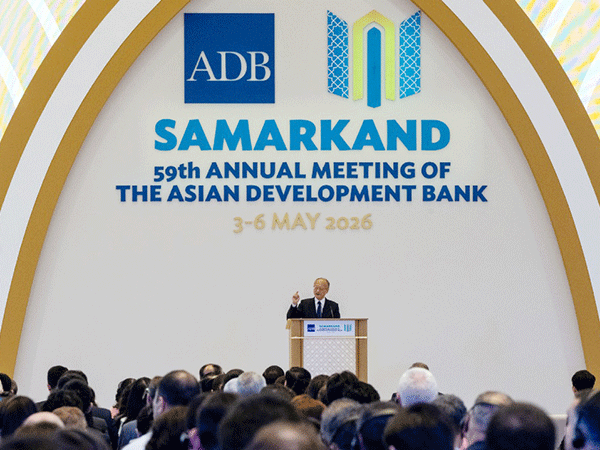
(China Daily/ANN) -- The Asia-Pacific needs to “act together to develop together” by strengthening cross-border connections to bolster resilience and inclusive growth, says Asian Development Bank President Masato Kanda.
“The decisions we make at this new crossroads will secure the future for the next generation,” Kanda told the opening session of the bank’s 59th annual meeting in Samarkand, Uzbekistan.
“In this fragmented world, traditional and isolated development responses will fail. To survive and thrive in this new era, we must build deeply connected and resilient systems,” he said, adding that shocks today travel rapidly across borders and hit communities that are least able to absorb them.
To address these challenges, the ADB pledged to back US$70 billion by 2035 for new energy and digital infrastructure, aiming to build regional systems that will strengthen shared security and resilience in the Asia-Pacific.
“Energy and digital access will define the region’s future,” Kanda said, announcing the launch of the Pan-Asia Power Grid Initiative and the Asia-Pacific Digital Highway.
“By linking power grids and digital networks across borders, we can lower costs, expand opportunity and bring reliable power and digital access to hundreds of millions of people,” he said.
The US$50 billion power grid initiative will link national and subregional grids, allowing renewable energy to flow across borders. The US$20 billion digital highway programme aims to narrow infrastructure gaps and support AI-driven growth.
The power grid plan marks a shift from country-to-country links to a regional power market. By 2035, the ADB aims to integrate about 20 gigawatts of renewable energy across borders, connect 22,000 circuit-kilometres of transmission lines, improve energy access for 200 million people, create 840,000 jobs, and cut regional power-sector emissions by 15 percent.
The digital highway initiative aims to provide first-time broadband access to 200 million people and faster, more reliable digital connectivity for another 450 million by 2035. It is expected to cut connectivity costs in remote and landlocked areas by about 40 percent and help create 4 million jobs.
Also in Samarkand, finance ministers and central bank governors from ASEAN+3 met on Sunday, discussing the economic impact of the Middle East situation and underscoring the need for stronger regional unity.
ASEAN+3 comprises member states of the Association of Southeast Asian Nations and their three East Asian dialogue partners — China, South Korea and Japan.
“ASEAN+3 entered 2026 from a position of relative strength …however, the escalation of conflict in the Middle East has amplified downside risks to the regional outlook significantly,” said a statement released after the meeting.
With growth expected to moderate and inflation to rise, finance leaders underscored the importance of upholding multilateralism and strengthening regional unity and cooperation in addressing shared challenges.
(Latest Update May 6, 2026) |