 |
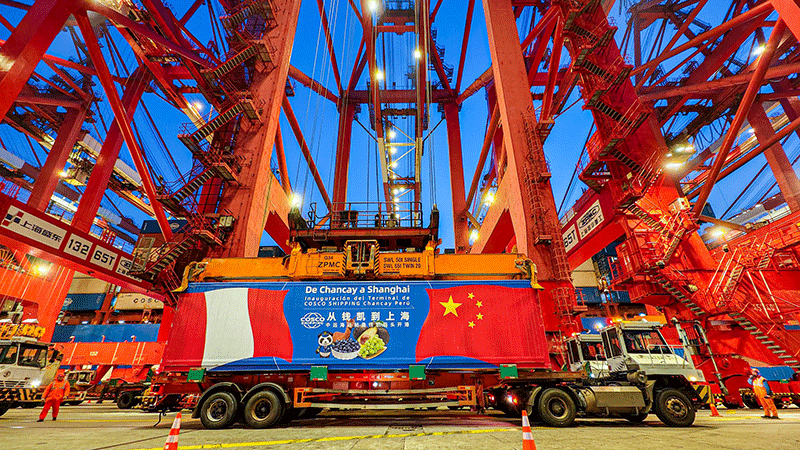
The vessel Xin Shanghai berth at Yangshan Port, Shanghai, after a 23-day journey from Chancay Port in Peru.
|
China-Peru FTA upgrade takes effect, boosting trade efficiency, investment opportunities and regional economic co-op
(Global Times/BRNN) -- With the upgraded China-Peru free trade agreement (FTA) taking effect, bilateral trade is expected to become more efficient through streamlined customs procedures and improved supply chain connectivity, creating new opportunities for businesses in both countries and giving fresh impetus to China-Latin America economic cooperation.
The upgrade will help Peruvian agricultural products, including blueberries, avocados and grapes, reach Chinese consumers more efficiently, while facilitating Chinese exports of automobiles, machinery and electronics to Peru. Chinese analysts said the agreement could also deepen cooperation in industrial chains, investment and emerging industries.
The protocol improves seven existing chapters, including rules of origin, customs procedures, trade facilitation and investment, while adding five new chapters covering standards and conformity assessment cooperation, competition policy, electronic commerce, global supply chains, and environment and trade, according to China’s Ministry of Commerce (MOFCOM).
The ministry said the agreement will create a more favourable business environment, expand trade and investment opportunities and bring more tangible benefits to both countries.
For Peruvian fruit exporters, the upgraded agreement could help address the challenge of getting fresh produce to Chinese buyers with fewer delays and more predictable customs procedures.
Gonzalo Matamala, managing director of Southeast Asia and China at INNOF Ltd, a company engaged in fruit trade between China and Latin America, told the Global Times that the upgrade’s greatest value lies in improving trade efficiency rather than cutting tariffs, as the original agreement already provided substantial benefits.
“A container of blueberries, grapes or avocados can lose significant commercial value because of a few days of delays,” Matamala said, adding that faster customs clearance and more predictable procedures could directly affect exporters’ profitability.
According to MOFCOM, the upgraded agreement introduces provisions on electronic networking and detailed arrangements for customs information exchange, cargo clearance, express shipments and perishable goods. It also strengthens transparency and consultation mechanisms concerning sanitary and phytosanitary measures.
The new arrangements could complement the logistics advantages brought by Chancay Port, a landmark Belt and Road Initiative (BRI) cooperation project inaugurated in November 2024.
The direct shipping route between Chancay and Shanghai has cut transportation time from more than a month to around 23 days, while reducing shipping costs by at least 20 percent, according to a Xinhua News Agency report.
In June 2025, Peruvian fruit producer Fruitist shipped its first batch of blueberries for the new season to China through Chancay Port. The shipment arrived in Shanghai about 10 days faster compared to previous transportation arrangements, according to Peru’s Ministry of Foreign Affairs.
In the first 11 months of 2025, the value of fruit imports from Peru through Shanghai ports rose 117.4 percent year-on-year to 2.6 billion yuan (US$390.78 million), according to Shanghai customs data cited by local media.
Matamala said improved shipping connections and trade procedures could strengthen Peru’s competitiveness in China, although the benefits would depend on how effectively customs authorities, shipping companies and exporters implement the new arrangements.
Jiang Shixue, distinguished professor from Hangzhou Normal University, also a Chinese expert on Latin American studies, said preferential trade arrangements could give Peruvian products a competitive edge over those from countries without similar agreements. However, he stressed that exporters must first identify market demand to benefit from such arrangements.
While improved customs procedures and shipping connections could benefit goods trade, the upgraded agreement also lays the groundwork for closer industrial and investment cooperation.
Pan Deng, director of the Latin America and Caribbean Region Law Centre at the China University of Political Science and Law, told the Global Times that bilateral trade has traditionally centered on resources, agricultural products and manufactured goods, leaving considerable room for closer cooperation in industrial chains and investment.
The upgraded agreement provides an institutional foundation for closer cooperation in industrial production, supply chains and investment, Pan said. Improved rules of origin and customs procedures could facilitate trade in intermediate goods, allowing Chinese equipment and technology to support Peru’s resource-processing industries and help the country develop local processing capabilities rather than relying mainly on raw material exports.
The new global supply chains chapter also encourages multimodal transport and logistics infrastructure development, while improved investment rules and cooperation on standards could reduce barriers to cross-border business, Pan said. The two sides have agreed to launch negative-list negotiations on services and investment within two years of the protocol’s entry into force, according to MOFCOM.
(Latest Update November 3, 2026) |