 |
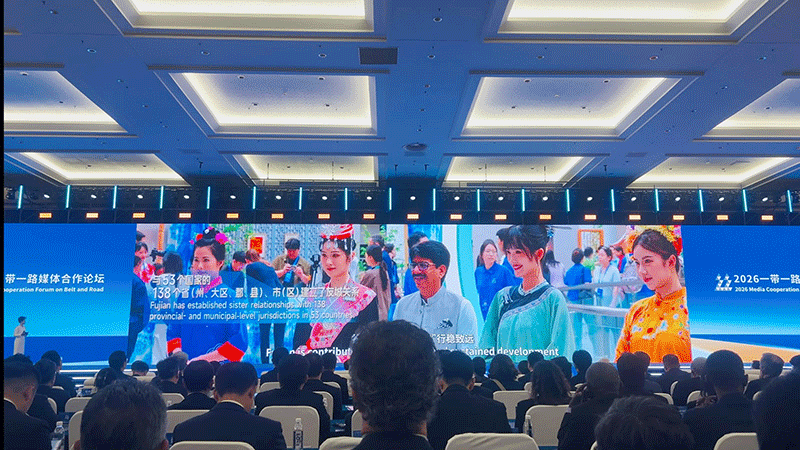
A video showcasing people-to-people links is screened during the opening ceremony of the 2026 Media Cooperation Forum on Belt and Road, which kicked off in Fuzhou, China, on Tuesday.
|
Laos-China Railway exemplifies BRI success at Fujian forum
Hundreds of global media delegates gather in Fuzhou to discuss regional connectivity, as cross-border Laos-China Railway passenger traffic jumps over 50 percent in 2026.
FUZHOU, FUJIAN PROVINCE -- The 2026 Media Cooperation Forum on Belt and Road opened on November 3 in Fuzhou, southeast China’s Fujian Province, gathering over 200 foreign representatives from 100 countries alongside 182 media outlets and international organisations.
Co-hosted by the People’s Daily and the People’s Government of Fujian Province under the theme “Pursuing Common Understandings and Shared Aspirations along the Belt and Road”, the gathering highlighted how physical infrastructure and constructive journalism work together to drive economic integration.
Throughout the forum’s opening ceremony and sub-forums, the Laos-China Railway was repeatedly cited as a flagship model of the Belt and Road Initiative (BRI).
Attendees noted how the initiative has grown into the world’s largest international platform for economic cooperation, transforming landlocked Laos into a regional “land-linked” hub.
Recent figures released by the railway operator highlight the real-world impact of the rail link. Cross-border passenger traffic on the Laos-China Railway surged by more than 50 percent in the first eight months of 2026 compared to the same period in 2025. The railway operated 972 international passenger trains during this eight-month period, making over 244,000 cross-border journeys.
Since its launch on December 3, 2021, the railway has operated 3,789 cross-border passenger trains and made 926,000 passenger journeys, transporting people from120 countries and regions. Operational capacity has expanded significantly to meet demand; daily international passenger train services running between Vientiane and Kunming have doubled from two to four, expanding seating capacity from 250 to 420 seats, while peak daily border crossings have reached 1,640 passengers.
Passenger convenience has been further enhanced through trilingual services in Chinese, Lao and English at major stations such as Xishuangbanna and Pu’er. Dedicated service windows, wheelchair access, and basic medicines are available for passengers with special needs, while customs clearance at the Mohan railway port now takes approximately 50 minutes.
With the total journey time between Kunming and Vientiane reduced to nine hours and 36 minutes, travellers can routinely leave in the morning and arrive at their destination by evening.
Freight corridors are expanding at a similar pace to bolster regional trade. On August 23, Guizhou’s first return freight train operating under the new “bonded logistics + fast railway customs clearance” model delivered 1,100 tonnes of Lao potash fertiliser from Vientiane South Station to Guiyang in just five days, opening direct logistics avenues for Lao products entering the Chinese market.
Forum participants stressed that physical infrastructure requires transparent, compelling storytelling to build enduring public trust and foster policy communication.
Following the main sessions in Fuzhou, media personnel will embark on reporting trips across Fujian and other areas of China to document trade and cultural achievements firsthand.
For Laos, the alignment of high-speed rail corridors with international media collaboration underscores a clear reality -- that while steel tracks forge trade routes, shared journalism builds the enduring understanding needed to sustain regional prosperity.
By Keoxomphou Sakdavong
(Latest Update November 4, 2026) |