Fuzhou Initiative sets blueprint for Belt and Road journalism
FUZHOU, China -- When international delegates gathered on November 3 for the 2026 Media Cooperation Forum on Belt and Road, the core takeaway extended far beyond celebrating 13 years of economic ties.
The central milestone of the event was the launch of the “Belt and Road Media Cooperation: Fuzhou Initiative”, a declaration that repositions global newsrooms not merely as observers of development, but as essential partners in bridging cultures.
Jointly hosted by the People’s Daily and the Fujian Provincial Government under the theme “Pursuing Common Understandings and Shared Aspirations along the Belt and Road”, the forum brought together over 200 foreign representatives from 100 countries, 182 media outlets, and regional institutions.
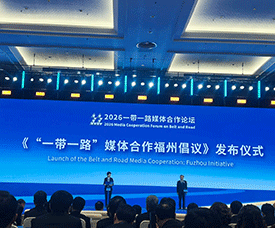 |
Launch of the Belt and Road Media Cooperation: Fuzhou Initiative during the 2026 Media Cooperation Forum on Belt and Road, on November 3.
|
While past milestones focused heavily on physical infrastructure such as ports, industrial parks, and cross-border rail links, the Fuzhou Initiative lays out a five-pillar framework designed to deepen the human side of global cooperation.
The initiative reaffirms that openness and mutual benefit remain the driving forces behind the Belt and Road Initiative (BRI) as it enters its high-quality development phase.
By prioritising links that directly improve daily livelihoods across partner countries, media outlets are urged to trace how macro-level policies translate into concrete economic progress on the ground.
Recognising the power of information in shaping global discourse, the initiative calls on journalists worldwide to maintain professional integrity, discard subjective bias, and counter misinformation.
By prioritising fair, evidence-based reporting, newsrooms can foster an environment of mutual trust where nations navigate shared challenges together.
Moving beyond traditional syndication, the initiative pledges deeper institutional collaboration through platforms like the Belt and Road News Network (BRNN).
This includes expanding joint field reporting, professional exchanges, and co-produced content, allowing journalists from diverse backgrounds to tell Silk Road stories through authentic, local perspectives.
As artificial intelligence and digital tools rapidly transform how news is produced and consumed, the initiative encourages media organisations to embrace digital transformation responsibly.
Leveraging modern tools enables high-quality storytelling particularly in green energy, digital infrastructure, and public health to reach broader global audiences across borders.
In a distinctive cultural framing, the initiative highlights Fujian’s identity as the only Chinese province featuring the character “Fu” (blessing). Drawing on the universal human desire for peace, wellbeing, and prosperity, the initiative uses “Fu” as a cultural bridge, calling on the media to serve as envoys of civilisational exchange and translate shared hopes into lasting international goodwill.
Following the official signing of the initiative, participating journalists are embarking on joint reporting tours across Fujian and neighbouring provinces. These field trips offer direct access to green development projects, modern industrial hubs, and community initiatives, putting the initiative’s call for collaborative storytelling into immediate action.
As physical trade routes continue to expand, the launch of the Fuzhou Initiative signals a clear evolution in regional development: enduring connectivity relies not just on steel and concrete, but on transparent, empathetic storytelling that connects people across borders.
By Keoxomphou Sakdavong
(Latest Update November 5, 2026) |